
What the $30 cleaning actually includes
Tau’s booking page offers a flat one-hour visit to selected San Francisco customers. Bedrooms and bathrooms are excluded unless the customer opts in, and any other room, area, or object can be marked off-limits before the visit.
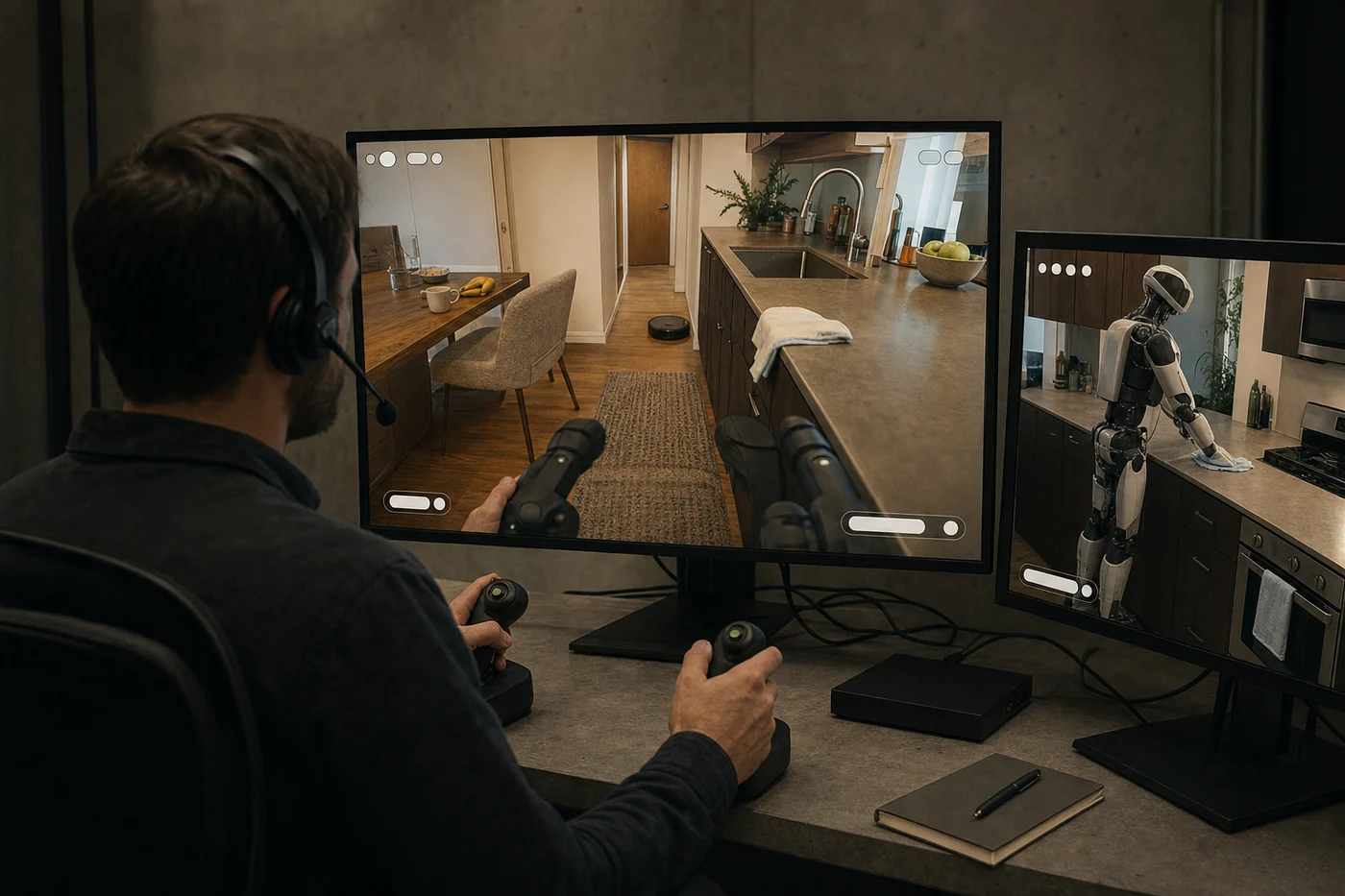
The company’s terms are blunt: ‘The robot is not autonomous. A person is controlling it.’ Tau says the operator is a background-checked employee working from its San Francisco facility, not a gig worker controlling the robot from home. The live feed goes only to an operator station inside that facility during the visit.
That honesty matters. Teleoperation is often hidden behind a polished robot video or described as occasional remote assistance. Here it is the current product. AI helps control the motors, but the human remains in the loop for every cleaning.
The capability is still narrow. Tau lists vacuuming, surface wiping, trash, and light clutter. Its terms exclude ladders, exterior work, biohazards, heavy furniture, medication, cash, and several other jobs. A UC Berkeley robotics professor told ABC7 he remains skeptical that today’s humanoids can deliver a broadly useful house clean, especially around picking up varied objects and reaching under or around ordinary clutter.
The cameras are part of the price
Tau’s service privacy policy says recording is not optional and ‘is why the service is priced the way it is.’ Cameras on the robot’s head and wrists capture continuous video, including rooms, belongings, and any people present. The system also records depth and room geometry, robot sensor data, operator commands, and notes about what happened during the job.
The microphones are disabled. The operator can speak through a one-way speaker but cannot hear the home. Tau also says it does not use facial recognition, does not build face templates, and does not sell the data or use it for cross-context advertising.
The retention terms deserve more attention than the hourly rate. Video and robot logs are kept indefinitely unless the customer requests deletion. The footage enters the training pipeline with faces unblurred. Tau says engineering staff, supervisors in limited situations, and contracted data-labeling providers may view stored recordings under access controls.
A deletion request removes raw video and telemetry and keeps that visit out of future training. It cannot remove the influence of footage already used to train a model. Tau explains that limit plainly. A customer still has to decide whether an after-the-fact delete is enough.
A cheap clean does not quite give you the hour back
This is not the leave-a-key-and-go-to-work version of house cleaning. An adult must stay home for the entire visit. Customers have to secure pets, put away fragile objects, clear unsafe floor clutter, disclose hazards, and provide a working internet connection. If the connection fails, the robot cannot work safely.
Those limits are reasonable for an early machine moving through a private home. They also change the value of the $30. The visit may remove an hour of vacuuming or counter wiping, but it does not remove all the setup, presence, or judgment around the job.
The fair comparison is not robot versus a science-fiction maid. It is robot service versus the cleaner, vacuum, or unfinished chore you have now. Ask what gets cleaned in sixty minutes, how much you have to prepare, whether you can do anything else while it works, and what happens when the robot cannot reach or recognize something.
That is a more boring test than watching a humanoid step out of a van. It is also the one that tells you whether the service returns time.
Teleoperation is not a trick. Hiding it would be.
A remote human can be the honest bridge between a lab demo and useful home robotics. People already supply the judgment behind self-driving tests, warehouse systems, delivery robots, and other machines that cannot handle every edge case alone. Home cleaning adds a harder environment: private rooms, pets, loose cables, family members, breakable objects, and a different layout at every address.
Tau’s version creates real training examples while delivering a service someone can buy today. That is more grounded than claiming full autonomy before the machine can handle a kitchen. It may also reveal which chores are worth automating and which still need hands, context, or trust that a remote service cannot provide.
But teleoperation moves the privacy boundary. Letting a cleaner into your home is familiar. Letting a camera-equipped robot stream the visit to another person and preserve the recording for model training is a different agreement. The robot body does not make the person behind it disappear.
Ivy sees an honest pilot. Mara sees a cheap-looking consent decision.
Ivy Chen thinks the human control is a strength if the service is described accurately. A household can judge a one-hour cleaning instead of betting on a future robot. Her adoption test is practical: after the visit, did the robot finish a named chore, did the customer have to rescue it, and was staying home worth the time saved?
Mara Vale is less comfortable with the checkout moment. Thirty dollars makes the booking feel low-stakes, while the recording license and training use reach well beyond the hour. She wants the service to put a short camera-and-retention summary beside the payment button, not only behind legal links.
Both views can be true. Human control may be the reason the service is useful now. Recorded homes may be the reason it gets better later. The customer should see both parts before deciding that the price is a bargain.
Five questions to ask before booking a robot cleaner
First, who controls the robot, and from where? ‘AI-powered’ does not answer whether a person is watching live or stepping in occasionally.
Second, what is recorded? Check for video, audio, room maps, faces, control inputs, and service notes. A camera-off mode may not exist.
Third, who can see the stored footage, and for how long? Live access and later access are different questions.
Fourth, what does deletion actually do? Ask whether it removes raw recordings, future training use, backups, and anything already learned by a model.
Fifth, what does the household still have to do? Count preparation, staying home, pet handling, failed-task cleanup, and the rooms or objects the robot cannot touch.
Tau answers more of these questions than many early robot services do. That deserves credit. The next proof is not a better launch video. It is an ordinary customer finishing the hour with a cleaner home, no ugly surprise, and a clear understanding of who just looked through the robot’s eyes.