
Why robot training needs more than video
Modern chatbots inherited a huge supply of text, code, images and video from the web. Robots need a different kind of example: an action tied to a physical result. A video can show that a hand picked up a mug. It may not capture grip pressure, a hidden finger position, the instant the mug started to slip or the small correction that prevented a spill.
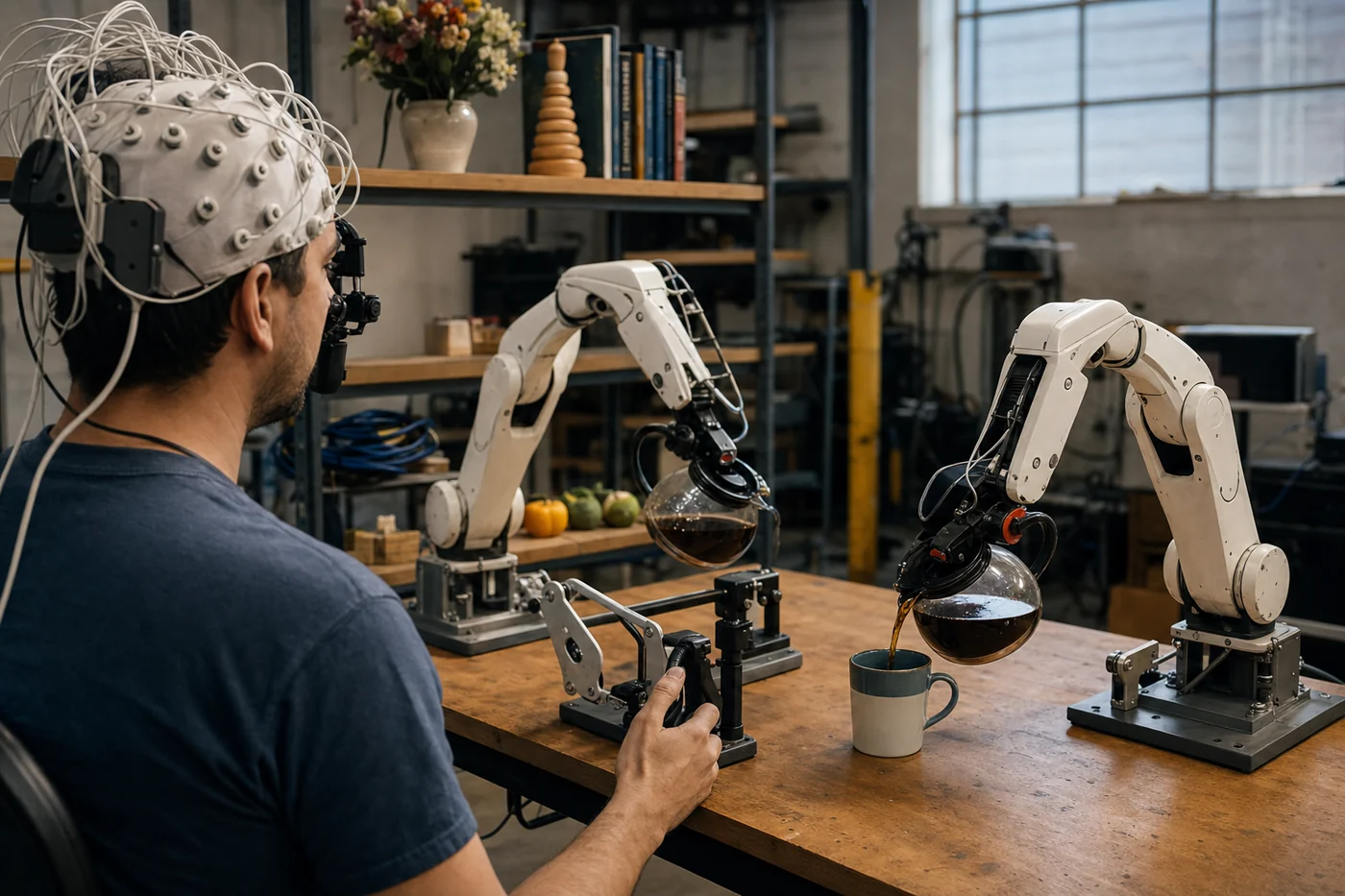
TechCrunch watched Encord trainers use paired leader-follower arms, with one arm controlled by a person and another copying the movement. Tasks included pouring coffee, stacking poker chips and plugging ethernet cables into a server. Encord is also testing forearm sensors that read muscle signals, hoping to reconstruct hand positions that ordinary video misses.
The work is expensive because the examples have to be made. Encord’s head of robot learning, Vineeth Velmurugan, said dense task annotations such as “right hand tightens bolt” can be worth far more than loose first-person footage for a specific skill, even though they cost much more to produce. His larger estimate—that robotics may need a corpus around five times the size of YouTube—is a company executive’s view, not an established industry requirement.
The practical point survives the big number. Physical training data is not sitting on a public website waiting to be scraped. It comes from rooms, objects, machines and people doing careful work.
What the EEG signal might add
Zander Labs works on passive brain-computer interfaces. Unlike systems where a person deliberately imagines a command, a passive interface tries to classify naturally occurring states while the person concentrates on another task. The company says its classifiers can identify patterns associated with workload, stress, surprise, error or intent.
For robot training, that could add a marker the teacher never had time to press. Imagine a trainer guiding a gripper toward a glass. The motion looks smooth on camera, but the trainer suddenly recognizes that the angle is wrong and corrects it. An error-related EEG signal could flag that exact window for closer labeling or a higher-effort model.
There is earlier research behind the general idea. In a 2016 Proceedings of the National Academy of Sciences paper, researchers used medial prefrontal brain activity as implicit feedback while people watched a cursor move toward a target. The signal helped a reinforcement-learning system improve its choices. That does not prove the Encord trial will improve robot manipulation. It shows that error-related brain activity has been used as a learning signal before.
The distinction matters. EEG does not produce a transcript of someone’s thoughts. It is noisy electrical data interpreted through classifiers. A label such as “surprise” or “error” is an inference, and the useful test is whether that inference helps a robot perform a held-out task more safely or reliably than video and control data alone.
Theo sees a promising experiment. Priya wants the comparison table.
Theo Marlow’s caution is about the claim itself. Zander’s work gives the idea scientific roots, but this specific Encord collaboration is still an initial trial. Until there is a held-out comparison showing that EEG-tagged demonstrations beat the same demonstrations without EEG, “robots learning from brain waves” is a research question, not a result.
Priya Rao starts one step later. If the trial reports an improvement, she wants to know the cost of getting it: headset setup time, calibration failures, unusable recordings, trainer fatigue, labeling time and the number of real tasks that improved. A better score on one block-stacking task may not justify adding sensors to every training shift.
The two views pull in the same useful direction. Do not dismiss the trial because the image looks strange. Do not promote the image into proof either. Ask what the extra signal changed, how often it worked and what collecting it required from the person.
Four questions to ask before brain data becomes job data
First: what leaves the headset? Zander Labs says its integrated system can process neural signals locally so raw EEG does not need to go to the cloud. The public reporting on Encord’s trial does not spell out its full storage and processing path. Workers should know whether the retained record is raw EEG, a derived label, a timestamp or all three.
Second: can the data be reused? Consent for one robot-training study should not quietly become consent for productivity scoring, hiring, insurance or a different model years later. The allowed purpose, retention period, deletion route and downstream recipients should be stated before recording starts.
Third: what happens when the classifier is wrong? Surprise is not incompetence. High mental effort may mean the task is genuinely hard, the equipment is awkward or the worker caught a problem early. An inferred state needs uncertainty attached to it and a correction path for the person it describes.
Fourth: does the signal help outside the demonstration room? Compare otherwise identical training sets with and without EEG tags. Test unfamiliar objects, different trainers and ordinary distractions. Report task success, failures, interventions and the extra human time required to collect usable data.
If this works, the most valuable part will not be that a robot can read a mind. It cannot. The value will be narrower: the robot’s lesson may finally include the moment its human teacher noticed something was going wrong. That moment belongs to the teacher first.