
No-code changes who can make the mistake
The appeal is obvious. The person who knows that the freight elevator closes early, the lunch queue spills into the corridor or the loading door sticks in wet weather is often not the person who writes robot software. A visual tool can put the local knowledge closer to the route.
It can also make consequential edits feel lighter than they are. A box labeled ‘deliver to floor seven’ compresses a chain of physical events: call an elevator, enter without trapping a person, exit before the doors close, cross a shared hall, find the right handoff point and recover when one of those steps fails.
The diagram needs to preserve that weight. A route edit should show which doors, lifts, public areas and notification rules changed. It should distinguish a harmless message edit from a movement change. And it should make the next physical test part of the edit, not an optional ceremony after someone clicks publish.
This is not an argument for keeping robot configuration obscure. Obscurity creates its own dependency: every small building change becomes a ticket, delay or workaround. The better bargain is understandable software with honest friction around the parts that move through shared space.
The ordinary building is the test bench
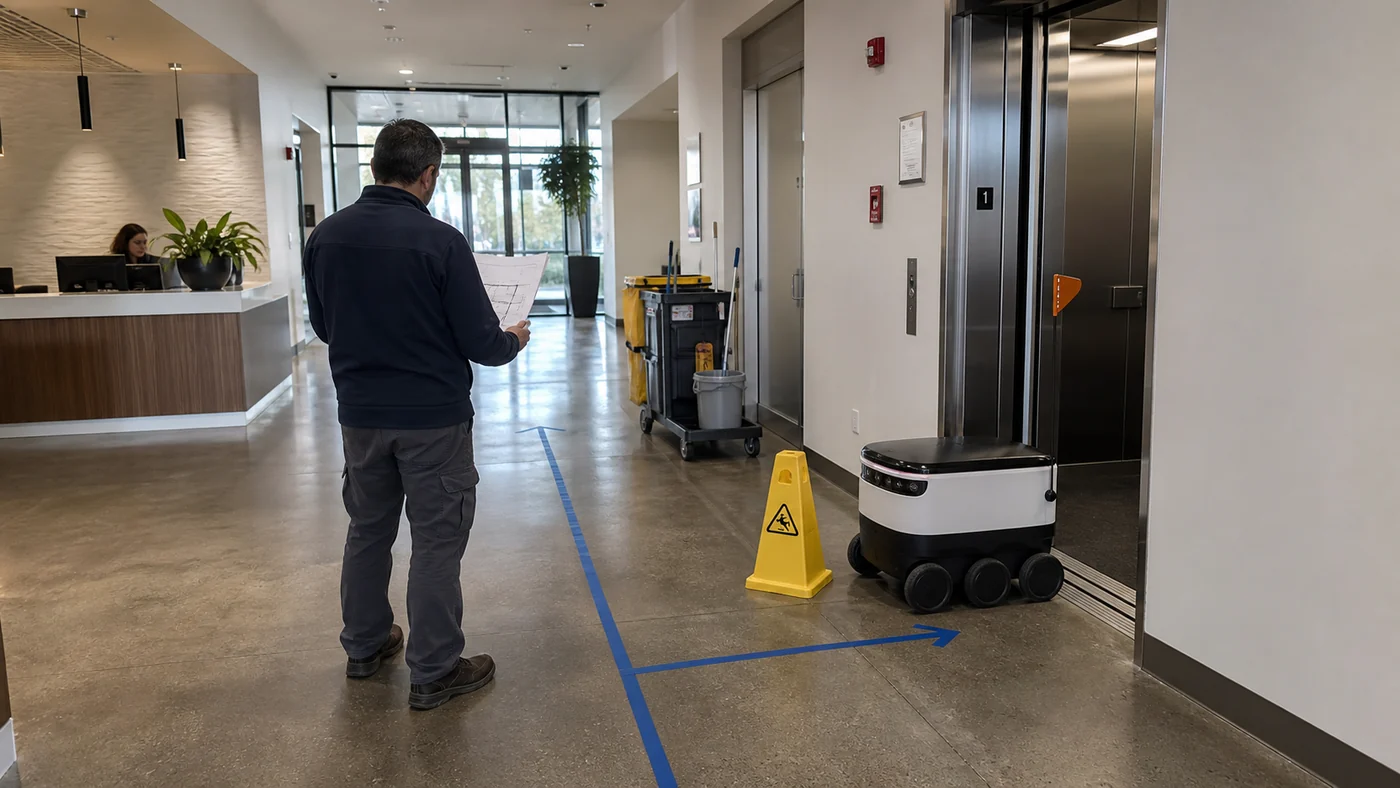
Start with the route at its busiest ordinary hour, not in an empty lobby after work. Put the cleaning cart where it usually sits. Let people call the elevator. Open the fire door. Interrupt the network. Have someone stand at the delivery point without knowing the setup story.
Watch the first failure all the way through. Does the robot stop somewhere visible and safe? Can a nearby employee tell why it stopped? Can the facility team resume or cancel the service without finding the one person who built the flow? Does the recipient get a useful update, or only a cheerful completion message after the machine gave up two floors away?
Naver's Tokyo account already names several of these unglamorous details: emergency-stop logic for hazardous areas, recovery after network disruption and an interface building staff without robotics expertise can understand. Those details matter more than the Android-of-robotics analogy. Platforms become real through exception handling, not category names.
The same principle applies beyond Naver. If you are evaluating robots for office delivery, cleaning or patrol, ask to see the service edited and then broken in your building. A polished route builder is evidence that setup may be easier. It is not evidence that the route is ready.
Ren wants the backup lead to run it. Ivy wants the support cost named.
Ren Ortiz likes the physical honesty of bringing configuration closer to the floor. His test is simple: give the new route to the person covering when the usual facilities lead is off. No private setup tour. Ask them to stop the robot at a changed elevator, correct the destination and resume after the corridor is blocked. If the flow only feels simple beside its author, the interface is borrowing expertise it claims to remove.
Ivy Chen is less interested in how fast someone can draw the flow than in what happens during week three. If every moved cart creates a ticket, every route change needs an engineer and every failed delivery sends staff hunting through logs, the no-code tool did not remove support work. It moved the support desk into facilities.
Those views pull in the right directions. Ren wants local people to have useful control. Ivy wants the vendor to stop calling transferred labor a product benefit. A good deployment needs both: the building team can make ordinary changes, while the system makes failures legible and keeps rare repairs from becoming a new part-time job.
A short field check before a robot route goes live
First, mark every point where the robot depends on something it does not control: elevator, door, network, access gate, crowded crossing, recipient or another service. Those are the places where a neat diagram can become a physical wait.
Second, preview the delta. Do not approve ‘route updated.’ Show the old path, new path, changed devices, changed notifications and the first safe rollback. A facility manager should be able to explain the difference without translating a machine log.
Third, walk it at reduced speed with the backup lead. Introduce one normal obstruction. Then test the stop, cancel and recovery paths before testing the happy handoff. If the robot leaves an object somewhere, make that location predictable.
Finally, review the first week by interruptions, not just completed deliveries. Count blocked routes, staff rescues, wrong-floor arrivals, network stops and recipient confusion. A route that completes 98 percent of jobs may still be a poor trade if the remaining two percent interrupt the same front-desk worker all day.
No-code robotics can be genuinely useful. The win is not that anyone can move a box on a screen. It is that the person who understands the building can change the service without losing sight of the bodies, doors and awkward corners underneath the box.