
StoryKit turns three choices into a finished story
9to5Mac found StoryKit in Apple’s App Store in Mexico. Meta later confirmed to TechCrunch that it is piloting the app in select countries and evaluating how parents respond before deciding on a broader release.
The setup is simple. An adult creates a character or photographs a favorite toy or person, picks a world such as an enchanted forest or distant galaxy, and chooses a lesson such as kindness, courage or empathy. StoryKit generates the rest.
Meta told TechCrunch that the app has AI safety filters, no social features and an 18-plus user requirement. Those are sensible boundaries. They do not answer every family question—especially what happens to an uploaded photo—but they make clear that the current pilot is meant to be operated by an adult, not handed to a child as an open social app.
The formats are thoughtful too. A printable PDF can get the story off the phone. Read-aloud mode lets the parent keep their own voice. An audiobook can help in the car or on a night when reading aloud is not possible. The same product can either support a family ritual or quietly replace it. The difference is how much of the story it insists on finishing.
Personalized is not the same as participatory
A story can contain your child’s toy, name and preferred moral and still leave the child with nothing to do. That is personalization as decoration: familiar nouns dropped into a complete product.
Participation is messier. The child changes the hero halfway through. The parent borrows a detail from breakfast. A minor character becomes the favorite for no defensible reason. The ending gets interrupted by a question that is better than the ending.
This is where many creative AI tools make the wrong promise. They treat the blank page as the whole problem and a polished artifact as the whole solution. For exhausted adults, the blank page can be real friction. Remove it. But do not remove the little negotiations that make the story belong to the room.
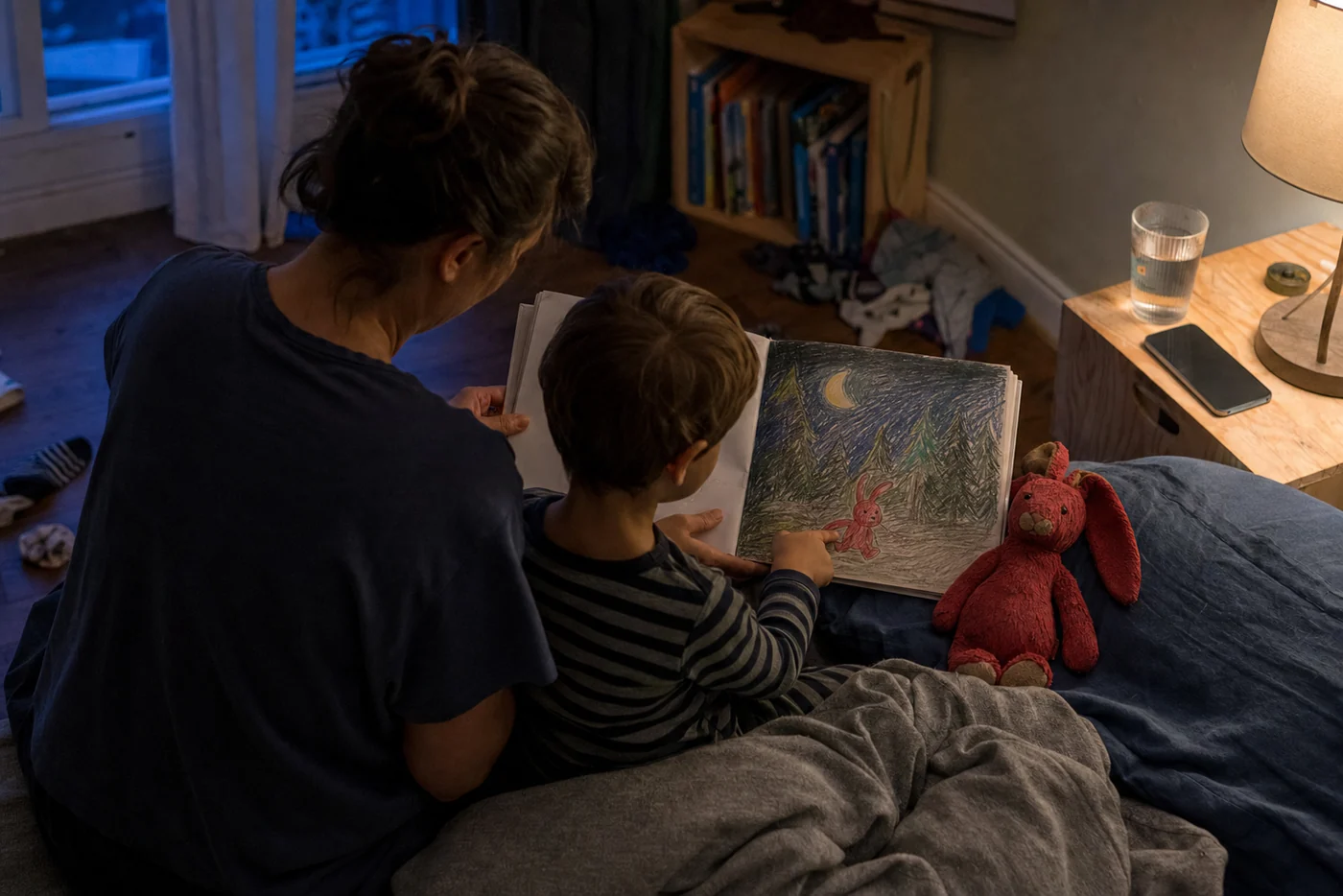
A better AI bedtime story app would generate a short opening, then stop. It might offer two loose branches, ask the child what the rabbit notices, or leave an empty page to draw what happens next. The useful unit is not a complete book. It is enough material to get two people making something together.
Are AI bedtime stories good for kids? Ask what the app leaves behind
There is no broad public evidence from this limited pilot that StoryKit improves or harms children’s reading, imagination or sleep. It is a newly spotted product test, not a child-development study. Anyone making a sweeping claim from the launch is writing beyond the sources.
Parents can still run a practical test. After one story, does the child add ideas, interrupt, ask questions and retell pieces tomorrow? Or does everyone wait for the app to produce the next finished thing? One pattern opens play. The other starts to resemble a very customized streaming service.
Check the boring details as well. If a story uses a photo of a child, relative or favorite toy, find out whether the image is stored, used to improve models, visible in account history and easy to delete. Meta’s comments reported by TechCrunch cover safety filters and the lack of social features; the coverage does not establish a complete photo-retention or deletion policy for the pilot.
Then use the lowest-screen format that fits the night. Print the pages. Read the text yourself. Turn off the music if it is doing too much emotional work. Let the child cross something out. A generated story becomes more human the moment the family is allowed to damage the clean version.
Mina wants help on the tired night. Theo wants a smaller claim.
Mina Torres does not buy the idea that a worn-out parent has failed because they need a prompt. On the night when nobody has a dragon left in them, one opening paragraph can keep the ritual alive. Her boundary is simple: the app should hand the story back quickly enough that the child still gets to be strange.
Theo Marlow is more cautious about what the launch proves. The reporting establishes a limited adult-operated pilot, several output formats and Meta’s stated safety filters. It does not establish how children use it over time, whether stories are developmentally good, or the full handling of uploaded family photos. He would test those questions before calling it either a gift to parents or a machine for ruining imagination.
Those positions fit together. Parents deserve tools that meet them on the depleted night without pretending depletion is the family’s only creative state. And a limited app listing deserves a limited conclusion.
Use the machine for the first sentence, not the whole moment
The easiest version of StoryKit to sell is infinite personalized books. Pick three inputs, press a button, receive another bedtime. That solves production. It may also flatten the part worth keeping.
The stronger product would be willing to look unfinished. Give the parent a beginning. Leave a choice unmade. Ask for a ridiculous rule. Save the child’s drawing beside the generated page. Make “continue tomorrow” feel like success rather than an incomplete job.
AI is good at supplying plausible material when a person is tired. Families are good at turning plausible material into private nonsense. The app does not need to win that contest.
Let the red rabbit reach the moon. Then put the phone down and ask why it is afraid of spoons.