
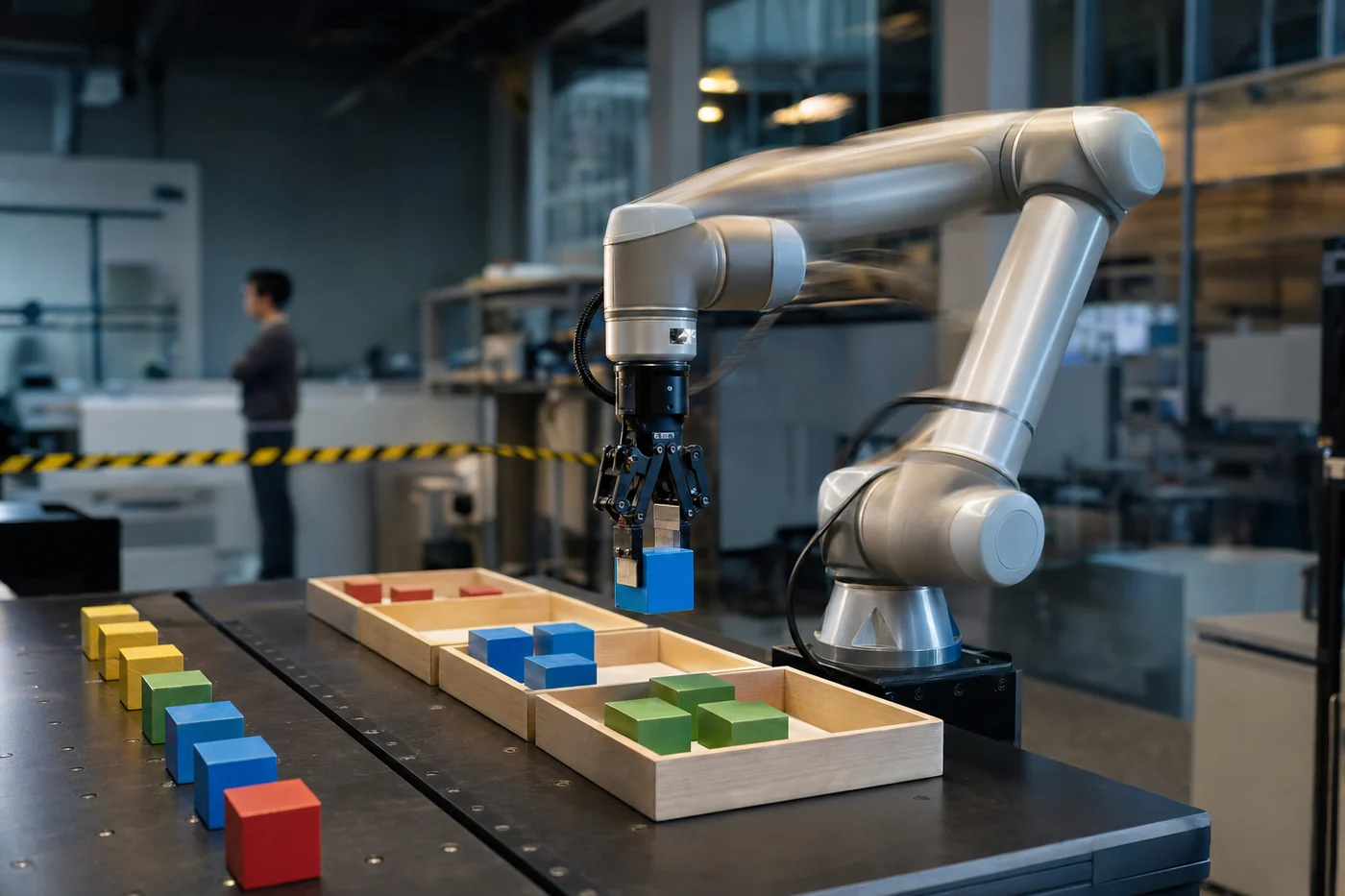
Why AI robots pause between movements
Many modern robots use vision-language-action models. The model looks at a camera view and a task instruction, produces a short chunk of movements, then sends those movements to the hardware. Under the ordinary synchronous approach, the arm can finish one chunk and wait while the model computes the next. That is the stop-and-think rhythm visible in many demonstrations.
Planning in parallel sounds like the obvious fix: let the arm execute one chunk while the model prepares another. The trouble is timing. By the time the new plan is ready, the arm has moved and the scene may have changed. A plan based on the old position can create a bad handoff between chunks.
VLASH rolls the robot's known movement forward and asks the model to plan for where the body should be when the next chunk begins. It cannot know every future change in the room, but it can stop treating the robot's own position as frozen in the past.
What the faster-robot result actually shows
The paper reports tests in simulation and on real robot hardware using multiple vision-language-action models. In the real-world comparisons, VLASH reached up to 2.03-times faster task completion and reduced reaction latency by up to 17.4 times while preserving the original accuracy. The team also demonstrated fast tasks including table tennis and Whack-a-Mole that the synchronous version could not handle well.
MIT News gives a concrete sorting example: the robot placed colored cubes into a box twice as fast as the comparison methods while matching the best baseline's 90 percent accuracy. Ninety percent matters as much as twice as fast. A ten-percent miss rate may be cheap when the object is a wooden cube and expensive when it is a glass vial, a connector or somebody else's hand near the work area.
The researchers also tested coarser action chunks, called action quantization. That made tasks faster again, but MIT reports a slight accuracy dip. This is the part a product demo can hide with a clean run: extra speed and the cost of that speed are separate settings, not one universal improvement.
A smooth demo can hide the old measurement problem
Priya's useful denominator is not frames per second. Start with 100 ordinary tasks and record how many finish correctly, how many need a human touch, how long recovery takes, and whether one miss forces someone to recheck the completed batch. Then repeat at the faster setting on the same task mix.
The before-and-after should include clutter and interruption. Move an object after the arm starts. Introduce a glare, a partial obstruction or a box in the wrong place. Measure stop distance, damaged items, false stops and the time until normal work resumes. A robot that reacts faster to the expected scene may still recover badly from the unexpected one.
This is not an argument for keeping robots slow. Slow, jerky motion creates its own problems and makes useful work uneconomical. It is an argument for treating speed as a tradeoff curve. The best setting is the fastest one that keeps errors contained and recovery boring.
Ren wants the last failed movement. Mara wants the worker's margin.
Ren Ortiz likes the physical clarity of the result: the arm can think and move at once instead of freezing between chunks. But he would put the final failures beside the best rally. Which object was moving, what changed in the scene, how far did the arm continue, and did it stop with the gripper empty or holding something awkward? The leftover miss tells a floor team more than another perfect pass.
Mara Vale sees a quieter issue. Workers learn the rhythm of machines around them. A long planning pause may be inefficient, but it is also a visible cue. Remove it and the safe operating procedure has to change with the speed. Marked zones, stop controls and training built around the slower machine should not be assumed to transfer unchanged.
Those positions are not in conflict. Faster reaction can make a robot safer when something changes. Faster continuous motion can also shrink the time a nearby person has to understand the change. Both belong in the pilot.
What to ask before speeding up a robot pilot
Ask for results at the speed you plan to use, on your objects and in your space. Do not accept a peak-speed clip beside an accuracy number measured under a gentler setting. Pair task completion time with intervention minutes, damaged parts, stop distance, false stops and recovery time.
Run the comparison for a full shift, not one clean sequence. Continuous motion changes wear, heat, battery use and how often a worker must reset the station. If output doubles but every miss reopens the whole batch, the speed gain belongs to the demo rather than the day.
The hopeful part is simple. Robots are getting less awkward because their models can plan while the body keeps moving. The honest next step is just as simple: test whether the people beside them get smoother work too.