
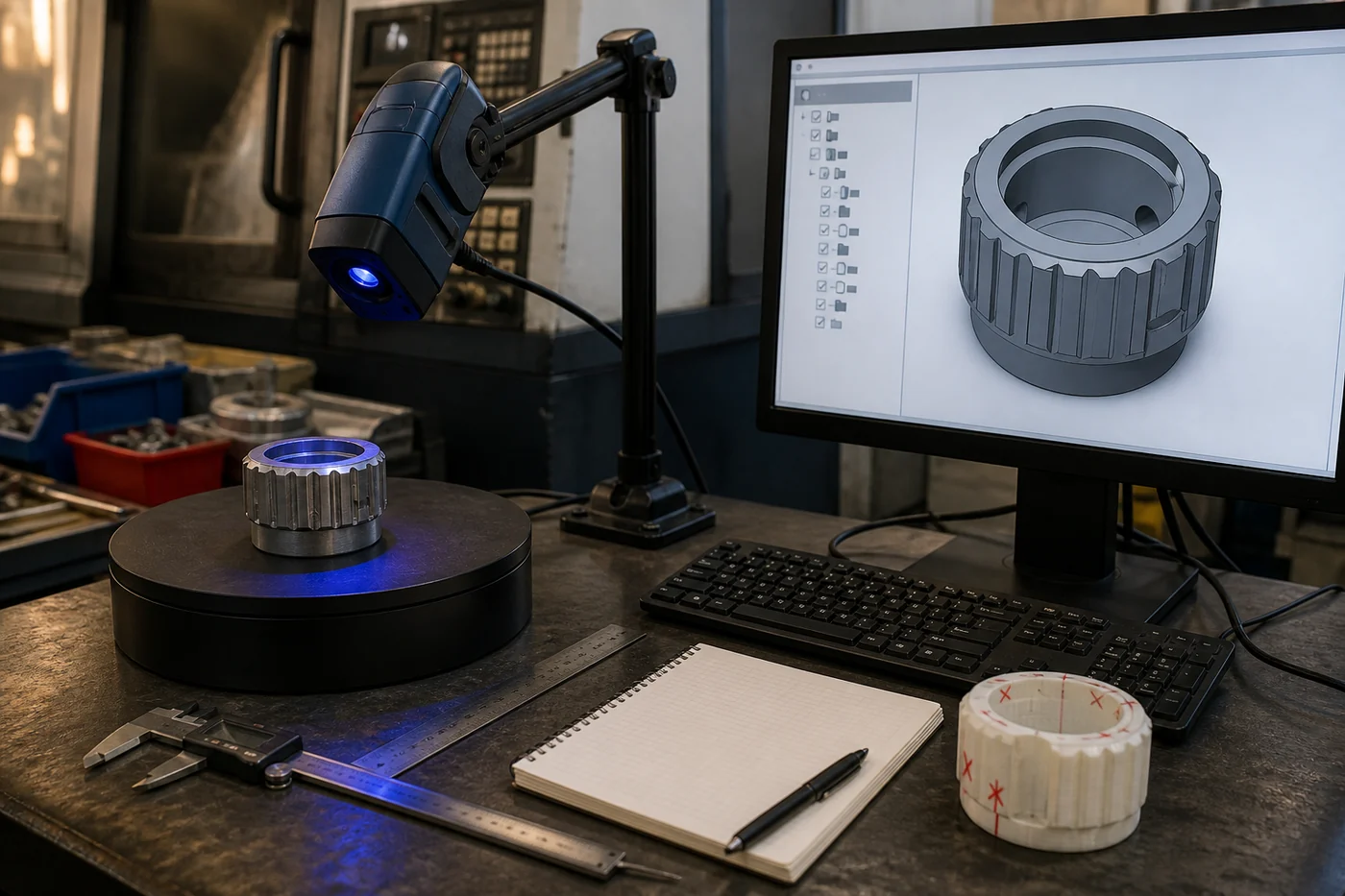
A mesh shows the skin. CAD keeps the decisions.
An STL is usually a shell made of triangles. It can preserve the shape well enough for viewing or printing, but it does not know that a round opening was meant to be a 12-millimeter hole, that six teeth share one pattern or that a face came from a single revolve.
Parametric CAD stores that construction logic. Open the feature tree and you can change a dimension, suppress a feature or rebuild the part around a different constraint without sculpting the surface again. For repair work, that difference matters. A worn part may need its original diameter restored, not copied exactly as the scanner found it.
Backflip says its second-generation model learned to chain ordinary CAD operations into native, editable geometry. The new product is available now as an Autodesk Fusion add-in and as a web app that exports STEP files. The company offers Fast mode, which returns several candidate constructions, and a slower Thinking mode intended for harder geometry.
The stated sweet spot is moderate-complexity, three-axis milled and turned parts. That is a useful boundary. A bracket, knob or adapter ring is a much saner first job than a turbine blade, a safety-critical steering part or a large assembly.
The first independent test found a shortcut, not a finished answer
Engineering.com editor Michael Alba tried the live product with an STL of a toaster-oven knob. Backflip returned four Fast-mode options and one Thinking-mode model after a few minutes. All looked close. None captured every detail.
A notch on the outer face was missed or modeled incorrectly. A thin inner wall appeared only in the Thinking result. Alba still found the editable starting point useful, though he noted that an experienced CAD user could have rebuilt that simple knob in a few minutes.
His second test went the other way. All four Fast-mode attempts failed on Backflip's adapter-ring example, while the Thinking-mode result looked flawless to him by eye. That split is more informative than a perfect launch demo: the slower setting can rescue some parts, but complexity is not the only thing that decides whether a feature survives.
There is also useful history here. Backflip showed an earlier Solidworks version in 2025, then left the product on a waitlist for 16 months. CEO Greg Mark told Engineering.com the first model was not good enough to ship because its CAD was awkward to edit. The launch version starts in Fusion and on the web; Solidworks and other plug-ins are still planned.
That does not prove the new model is broadly reliable. It does show the company killed a weak version instead of turning a live demo into a permanent claim. Now normal parts can provide the harder proof.
The $1,500-to-$10 claim is a vendor estimate
Backflip says manual reverse engineering often costs about $1,500 per part and that its model can cut the conversion itself to roughly $10 and one to five minutes. The company also says the software is deployed at an unnamed automotive manufacturer and can digitize about half the parts placed into a small scanning station there.
Those numbers come from Backflip. The company has not published the customer's identity, the part set, the accuracy tolerances, the amount of human correction or the final inspection cost. DEVELOP3D repeats the estimate as Backflip's claim rather than an independently measured result.
The missing denominator matters. Ten dollars for a first draft is excellent if an engineer spends five minutes checking it. It is less impressive if the scan misses a small feature, the team prints the wrong part and the line waits through another attempt.
Pricing is easier to verify. Backflip says a free account includes four conversions and paid plans start at $20 per month. Engineering.com reported that individual jobs consume credits and work out to roughly $1.52 to $10 depending on the plan and mode.
Ren wants the worn part separated from the intended part. Priya wants the whole correction bill.
Ren Ortiz likes the physical shortcut, but he would not let the scanner decide what counts as truth. A worn bushing, bent tab or rounded tooth is evidence of the part that came out of the machine—not necessarily the part that should go back in. He wants the first review to mark which dimensions are measured, which are inferred and which must be restored from another reference.
Priya Rao would test twenty ordinary parts before believing the cost headline. She would record scan time, AI time, correction time, missed features, dimensional errors, failed exports and whether the first manufactured piece fit. Her useful number is not cost per generated model. It is cost per verified part ready for the next step.
Ren is protecting the physical world from a plausible copy. Priya is protecting the time claim from hidden cleanup. Together they land on a simple rule: editable AI output is valuable because a person can correct it. That correction still belongs in the estimate.
Try one boring part before scanning the factory
Pick a non-safety-critical part with simple geometry and a known fit: a knob, spacer, jig foot or cover plate. Avoid anything carrying a person, pressure, high voltage or a heavy load. This is a software test, not permission to skip engineering judgment.
Measure five dimensions before uploading the scan. Include one easy feature the eye might miss: a shallow notch, thin wall, counterbore or small fillet. Save those numbers somewhere outside the generated file.
Run Fast mode first. Do not choose the prettiest model. Open each feature tree and ask whether the construction makes sense. Then run Thinking mode and compare the same five dimensions. If the shape is close, change one dimension on purpose. A real parametric model should accept the edit without the rest of the part collapsing.
Export the file, reopen it in the CAD package you actually use and make a cheap prototype or fit-check piece. Record every correction and the minutes it took. If the generated model saves time after inspection, keep the part class. If review costs as much as rebuilding, the tool has not earned that lane yet.
That is the practical news in Backflip's launch. AI did not eliminate CAD. It moved one tedious job from a blank screen to an editable first draft. For a shop with a shelf of undocumented parts, that could be a very good trade—as long as the caliper gets the last word.