
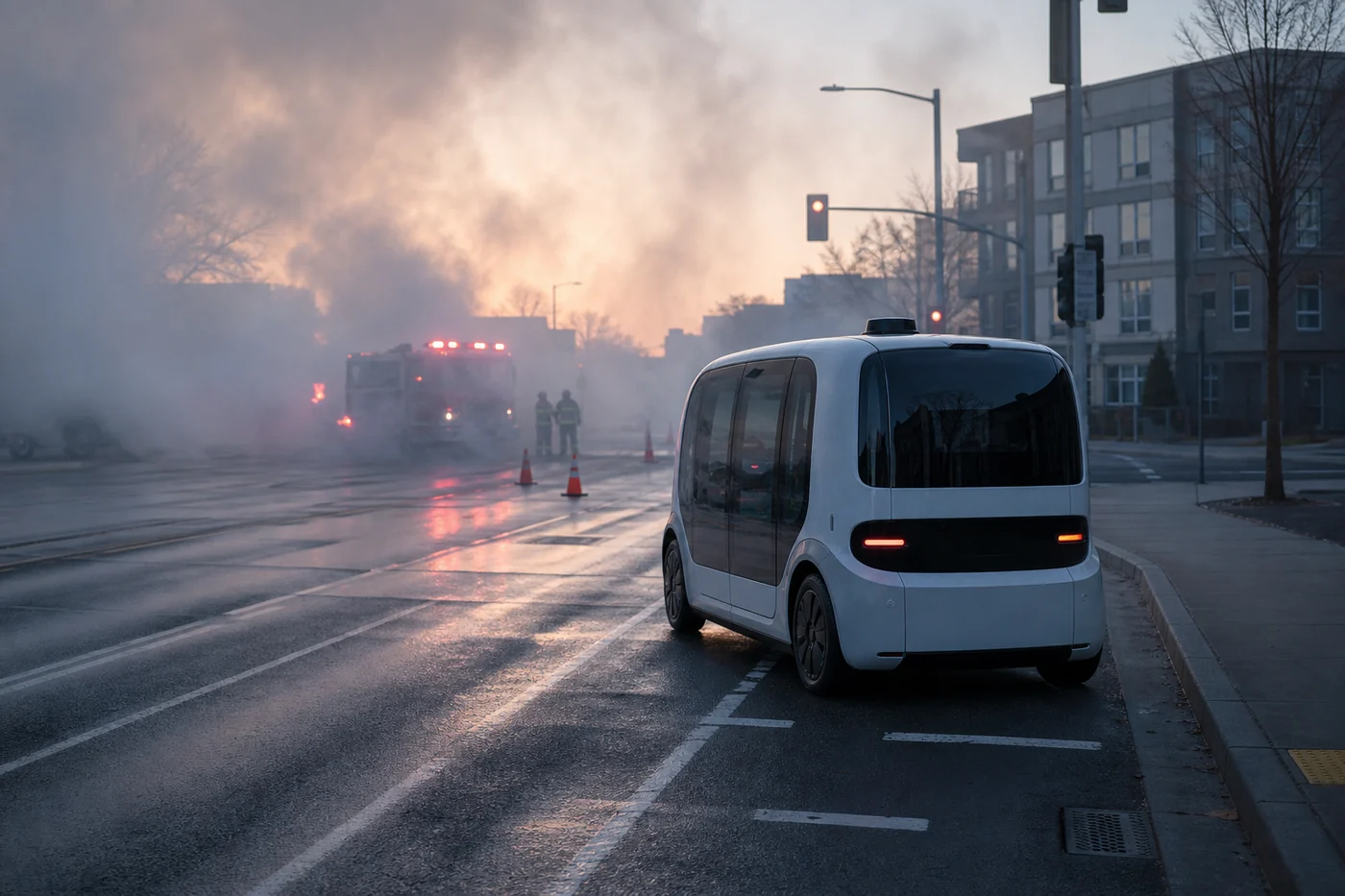
The missing cones are not an excuse
A neat test scene would have cones in a straight line, visible lane markings and an obvious route around the hazard. Real emergencies begin before any of that exists. Smoke hides the road. Firefighters arrive from different directions. A police officer may use a hand signal that does not match the light. Vehicles and equipment stop wherever they have to.
The Zoox filing says the fire scene had not been cordoned off when the vehicle arrived. That detail matters because it exposes a weak measurement. A car can score well at following established traffic controls and still be poor at recognizing that the usual controls no longer apply.
NHTSA Administrator Jonathan Morrison made the same point more broadly in a July 8 letter to driverless-vehicle developers. The agency says it has documented vehicles entering active scenes, blocking ambulances and firefighters, and failing to respond to flashing lights, flares, smoke, fire and cones. It called these failures a functional insufficiency, not a rare edge case.
One incident can still reveal a bad denominator
Zoox reported one heavy-smoke event in this review. That does not tell us the failure rate because the public does not know how many comparable smoke-obscured scenes the fleet encountered and handled correctly. One failure divided by all autonomous miles would look tiny. One failure divided by one relevant fire scene would look very different.
The right denominator is exposure to the condition being tested. For emergency-scene performance, that means encounters with smoke, active responders, blocked or improvised lanes, manual traffic direction, flares, damaged signals and missing cones. Publish the number of encounters, the number handled without intervention, the number that needed remote help and the minutes the vehicle occupied a responder's attention.
This is not an argument for waiting until a vehicle has seen every possible disaster. It is an argument for measuring the public consequence. A conservative stop may be safe in ordinary traffic and still be harmful if it blocks a fire engine. A remote recovery may be successful and still be too slow for an ambulance route.
What the software update has to prove
The recall report says Zoox added the ability to detect and respond to heavy smoke in certain situations. Useful follow-up evidence would show how the fleet behaves across smoke density, lighting, wind, obscured lane markings and different emergency vehicles. The result should include false alarms too. A robotaxi that freezes for every patch of fog or exhaust may create another road hazard.
I would track five things: emergency-scene encounters, correct early yields, wrong entries, remote-assistance time and responder delay. Then add near misses and unnecessary hard braking. The goal is not a perfect demo. It is fewer moments when a firefighter, paramedic or police officer has to spend attention managing an empty car.
The update also needs a regression test. Heavy-smoke detection cannot quietly make the vehicle worse around fog, dust, steam or ordinary exhaust. Software recalls move faster than mechanical ones, which is useful. The trade is that the proof has to move just as fast and stay visible after the headline passes.
Two views from the street
Mara Vale is focused on the scene before it becomes orderly. Cones are evidence that people already understood the danger and had time to mark it. A safe vehicle cannot make its best behavior depend on first responders finishing the setup before it arrives.
Ren Ortiz is looking at the remote recovery. The employee who guided the car backward was part of the safety system, not a footnote. The public test should include how quickly that person saw the problem, understood the scene, communicated with local responders and cleared the lane.
Both views point away from the usual miles-driven victory lap. Most miles are not the test. The strange, urgent minute is.
What this means before you book a robotaxi
Passengers cannot audit a driving stack before a ride, and they should not have to. Regulators and operators can make the useful evidence easier to see: emergency-scene incidents, response updates, remote-intervention rates and what changed after each failure.
A software recall is not proof that self-driving cars are hopeless. It is the system doing one necessary thing: turning a field failure into a fleet-wide fix. Trust comes from what happens next—whether the fix survives messy scenes, whether new side effects are reported and whether emergency crews spend less time babysitting vehicles that have no driver to wave through.
The public promise of self-driving cars is safer, easier travel. On the worst day on a street, that promise begins with a simpler duty: do not become another problem for the people already responding to one.